
Introduction: A Question That Comes Up Again and Again
Every week at Digi Com, we meet project owners — entrepreneurs, NGO managers, SME leaders, public institutions — who almost all ask us the same question within the first few minutes of our conversation: "What technology should we use for our website or app?" It's a legitimate question, but it's often asked backwards. Before talking about technology, we need to talk about needs, context, and objectives. Technology is never an end in itself: it is a means to achieve a concrete business outcome.
In this article, we want to share the method we apply at Digi Com to guide our clients through this decision, in order to demystify a topic that often seems reserved for developers alone, when in fact it directly affects the sustainability and profitability of your digital project.
Why the Tech Stack Is Never a Trivial Question
Choosing a tech stack — meaning the set of programming languages, frameworks, databases, and tools used to build your solution — has consequences that go well beyond the technical realm. It directly influences:
- Initial development cost, as some technologies require more time or specialized skills, resulting in a higher budget.
- Long-term maintenance cost, as some solutions are simpler and cheaper to evolve than others.
- Time to market, often a decisive factor when you need to quickly test an idea or seize a business opportunity.
- Scalability, meaning how easily your solution can grow, accommodate new features, or support a growing number of users.
- Availability of local talent to ensure long-term maintenance, a particularly important concern in the Malian context where certain technical profiles remain scarce.
A poor technical choice, made without prior thought, can be costly — not just financially, but also in lost time and missed opportunities. Conversely, a well-considered choice, aligned with your actual goals, becomes a genuine competitive advantage.
Essential Questions to Ask Before Any Technical Decision
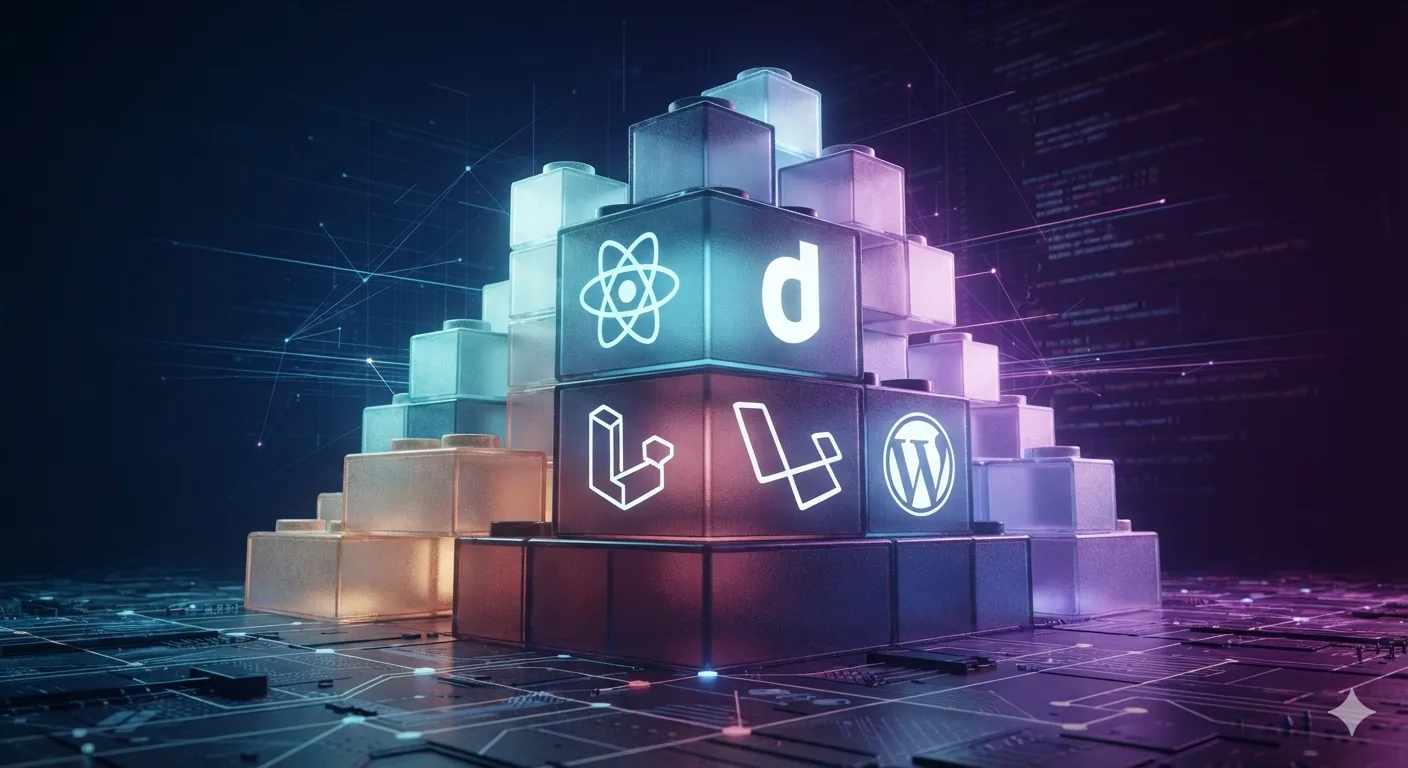
Before choosing between React, Vue, Angular, Django, Laravel, WordPress, Shopify, or even a no-code solution, we recommend taking the time to honestly answer the following questions:
1. How complex is your project really?
A showcase website presenting your company, services, and contact information doesn't have the same technical requirements as an e-commerce platform with inventory management, multiple payment systems, and real-time order tracking. Similarly, a simple appointment-booking mobile app is fundamentally different from internal management software connected to several databases. The more complex your project, the more important it becomes to invest in a robust architecture from the start.
2. What's your budget today, and for future growth?
Some technologies let you get started quickly at a lower cost — as is the case with solutions like WordPress or certain no-code tools — but may become more expensive or more limited as the project grows. Others require a larger upfront investment but offer better long-term scalability in return. It's essential to think not only about launch cost, but also about the total cost of ownership over three to five years.
3. Who will maintain the solution after launch?
A very modern stack, at the cutting edge of technological innovation, may seem appealing on paper. But if it remains rare in the local job market, you risk facing difficulties recruiting or growing your technical team in the future. This criterion, often overlooked, is nonetheless crucial for the longevity of your solution.
4. What are the connectivity and usage constraints of your users?
In Mali, as in several countries in the sub-region, internet connectivity remains variable depending on the geographic area, and a significant share of users access the internet primarily via smartphone. These realities should shape your technical choices: favoring lightweight architectures, optimizing loading times, planning for degraded functionality in case of unstable connections, and adapting interfaces to smaller screens.
5. What are your medium-term growth objectives?
A project intended to remain small-scale doesn't need the same architecture as a project aiming to reach several thousand users within the next two years. Anticipating this trajectory, even roughly, helps avoid a costly technical overhaul just months after launch.
The Trap of the "Latest Trendy Framework"
In the digital development industry, trends are very real. Every year, new frameworks emerge, presented as the ultimate solution to every technical problem. Some agencies, sometimes due to a lack of real experience and sometimes for purely commercial reasons, systematically recommend the newest technology to their clients, regardless of its actual relevance to the project at hand.
At Digi Com, we firmly favor a pragmatic approach. A proven technology, widely used in production worldwide, backed by extensive documentation and an active community, generally offers more guarantees of stability and longevity than an emerging trend that still lacks maturity. This doesn't mean ignoring technological innovation — quite the opposite — but rather adopting it with discernment, at the right time, for the right project.
Case Study: Two Profiles, Two Different Approaches
To illustrate this thinking concretely, let's look at two representative examples of situations we regularly encounter in Bamako.
First case: a clothing boutique wanting to sell online. The main objective is to launch quickly, on a limited budget, while integrating mobile money payment. In this context, a solution like WordPress combined with an e-commerce plugin, or a turnkey e-commerce platform, is often the wisest choice: quick to set up, cost-effective, and sufficient for the business's actual needs at this stage.
Second case: a financial services company wanting to develop a client account management application. Here, the requirements for security, reliability, and scalability are much higher. A custom architecture, built with technologies like React for the interface and Django or Laravel for the backend, combined with a robust database, becomes essential to guarantee data security and the system's ability to scale with the company's growth.
These two examples illustrate a simple truth: there is no universal solution, only solutions suited to specific contexts.
Our Approach at Digi Com
As a full-stack agency, we have made the choice never to sell a single technology to our clients. Our working method always begins with a phase of listening and in-depth analysis of your actual needs, available budget, and growth roadmap. Only after this analysis do we recommend the most relevant technical approach for your specific project — whether that's React and Django for a scalable custom application, WordPress for an institutional site to be set up quickly, Laravel for a robust business management system, or a no-code solution to quickly validate a prototype before investing further.
This approach allows us to guarantee our clients a solution that is genuinely aligned with their needs, rather than one aligned with our technical preferences or market trends.
A Practical Checklist Before You Get Started
Before starting any digital project, we invite you to formalize the following elements, either on your own or with the help of a trusted technical partner:
- Clearly define the project's main objective and expected outcomes at six months, one year, and three years.
- Estimate a realistic budget, including not just initial development but also hosting, maintenance, and future upgrades.
- Identify your target users' profile and digital habits (device type, connection quality, language).
- Anticipate your integration needs with existing tools (mobile money payment, social media, internal management tools).
- Research the availability of local technical talent for long-term maintenance.
Conclusion
There is no "best tech stack" in absolute terms: there is only the stack best suited to your context, your budget, and your ambitions. Taking the time to answer the right questions before committing technologically will save you a great deal of frustration, unexpected costs, and rushed overhauls. At Digi Com, we support Malian businesses and organizations through this thinking process, with the sole goal of guiding you toward the solution that will genuinely serve your growth — feel free to reach out to discuss your project.